World Communication Week: 3 Things Every Business Should Expect From Their Commercial Data Cabling Contractor
World Communication Week: 3 Things Every Business Should Expect From Their Commercial Data Cabling Contractor
World Communication Week is a time to recognise the importance of communication and the technology that brings people, businesses and communities together.
From a simple phone call or email to complex business networks connecting thousands of people across multiple locations, communication plays a vital role in almost everything we do.
For businesses in particular, staying connected is no longer optional. Employees rely on technology to share information, customers expect reliable communication and organisations depend on their networks to keep day-to-day operations running smoothly.
But while we often celebrate the technology that keeps us connected, how often do we think about the infrastructure sitting behind it?
Because every reliable business network needs more than just cables running through a building. It needs the right design, quality products, professional installation and thorough testing.
This World Communication Week, we're looking at what businesses should expect from their commercial data cabling contractor and why three fundamental things really matter:
Standards. Testing. Cables & Components.
At Integral Network Solutions Ltd, we call this our Golden Triangle, and it's the foundation of a quality cabling installation.
1. STANDARDS – Is Your Cabling Being Designed and Installed Correctly?
A professional data cabling installation should never be based on guesswork.
Before any cables are installed, your contractor should understand your building, how the network will be used, the number and location of connections required and any future expansion plans.
This is where industry standards come in.
Two particularly important standards for structured cabling are:
BS EN 50173 – Information Technology: Generic Cabling Systems
This standard covers the design and performance requirements of structured cabling systems. It helps establish what a properly designed cabling infrastructure should look like.
BS EN 50174 – Information Technology: Cabling Installation
This covers the planning and installation practices for information technology cabling, including important considerations such as cable routing, installation conditions and separation from other services.
What should you expect from your cabling contractor?
Your contractor should be able to explain:
How they have designed the cabling system around your requirements.
Why they've recommended Cat6, Cat6a or Fibre Optic cabling.
How cable routes and containment will be planned.
How the installation will comply with the relevant industry standards.
How the system will accommodate future growth and changes.
How fire performance and building requirements have been considered.
For example, Cat6 cabling might be perfectly suitable for one business, whereas another may benefit from Cat6a to support higher bandwidth requirements or a more demanding network environment.
The right solution should be based on what your business needs, not simply what is cheapest or easiest to install.
Our advice: Ask your contractor which standards they work to and how these are applied to your project. If they can't explain their approach, it's worth asking more questions.
2. TESTING – Don't Just Take Their Word For It!
This is one of the most important areas of any commercial data cabling installation.
Imagine paying for 200 new network connections, only to discover months later that some aren't performing properly.
Would you know which cables had been tested? Would you have the results? Could your IT team identify exactly where the problem was?
A professional installation should include proper testing, not simply plugging in a laptop and checking whether an internet connection appears to work.
What is the difference between basic checking and certification testing?
A basic connectivity check might establish whether a connection appears to work.
However, professional certification testing goes much further.
For copper cabling, a suitable cable certifier measures performance against the required cabling category and link configuration. Depending on the test, this can include:
Wire mapping: Checking that conductors are correctly connected.
Length: Measuring the cable length.
Insertion loss: Measuring signal loss through the cable.
NEXT: Checking for near-end crosstalk between pairs.
Return loss: Measuring signal reflections caused by impedance variations.
Propagation delay and delay skew: Checking signal timing.
For fibre optic installations, testing should establish that the installed fibre meets the required performance criteria. This can include checking polarity, continuity and optical loss, with results recorded against the specified link requirements.
For more demanding fibre projects, additional testing such as Optical Time Domain Reflectometry (OTDR) may also be required.
What should you expect from your cabling contractor?
A professional contractor should:
Test every installed copper data link.
Test every installed fibre core.
Use appropriate, calibrated professional testing equipment.
Test against the correct category or fibre specification.
Provide individual test results, not just tell you everything passed.
Identify and rectify failed links before handing over the installation.
Supply testing documentation as part of the handover.
You should also ask what happens if a cable fails its test. A good contractor should investigate, rectify the issue and retest until the installation meets the required specification.
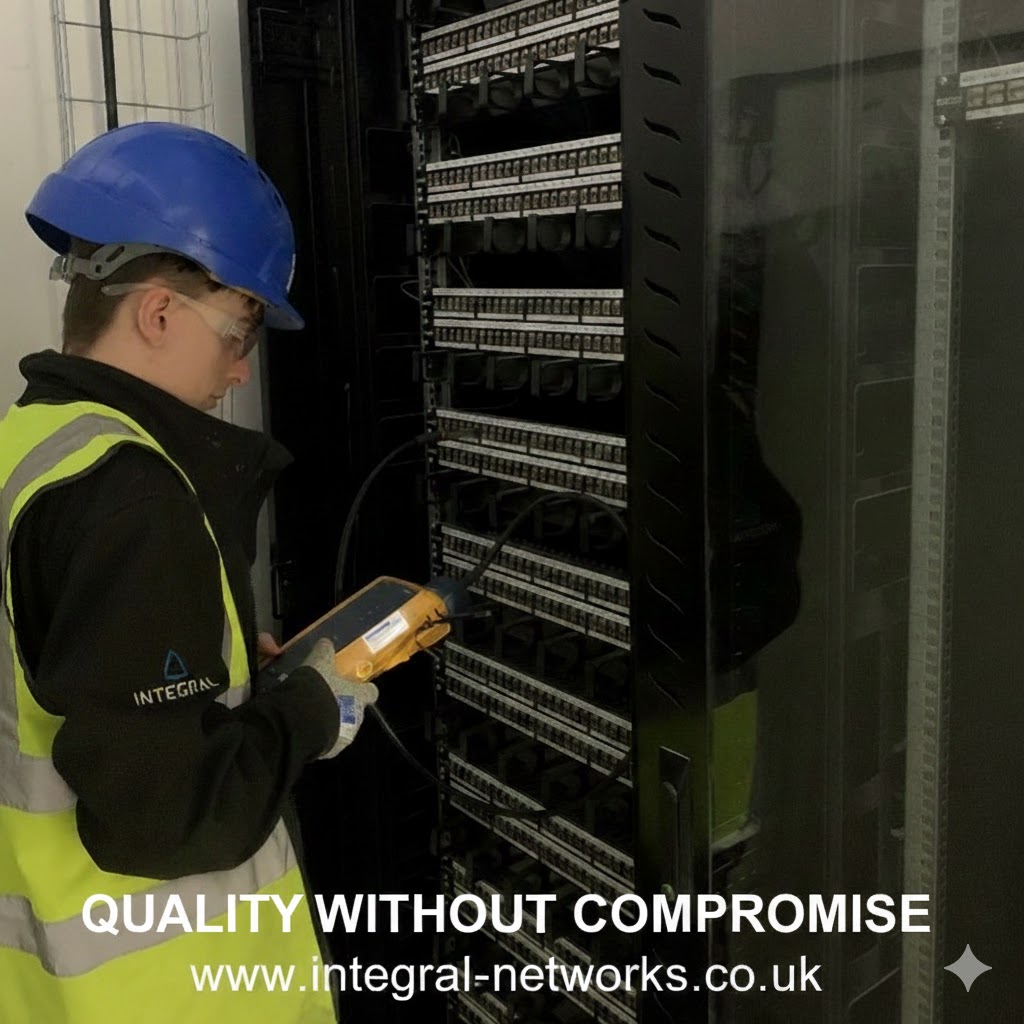
At Integral, we use professional Fluke testing equipment and record the results of our installations.
We believe that if we're installing your network infrastructure, we should be able to demonstrate that it meets the required performance criteria.
Our advice: Never be afraid to ask for the test results. They are an important part of your installation records and something your IT team may need in the future.
3. CABLES & COMPONENTS – Are You Getting Quality Products?
Not all data cabling products are the same.
It's easy to compare two quotations and assume they're offering exactly the same thing because both say Cat6 or Cat6a.
But the cable itself is only one part of the system.
A structured cabling installation includes a range of components, all of which need to work together to deliver the required performance.
These can include:
Copper data cables.
Fibre Optic cables.
Patch panels.
Network outlets and modules.
Patch leads.
Fibre enclosures and termination units.
Connectors and associated accessories.
The quality, compatibility and specification of these products matter.
What should you be looking for?
Correct cable specification
Make sure the contractor clearly identifies the cable category and specification being installed. Cat6 and Cat6a are not interchangeable descriptions, and your chosen system should meet your business's requirements.
Copper or fibre?
Copper cabling is commonly used for connections to individual network outlets and devices.
Fibre Optic cabling is particularly useful for backbone connections, longer distances, connections between buildings and applications requiring higher bandwidth.
Your contractor should explain why they've recommended a particular solution.
Quality and compatibility
Ask which manufacturer and product range they are proposing to use.
Using compatible products from a recognised manufacturer can help ensure the complete cabling system performs as intended and may provide access to manufacturer-backed system warranties, subject to the manufacturer's requirements.
Genuine product certification
Don't be afraid to ask for product datasheets and evidence that the proposed components meet the relevant specifications.
A cheap cable isn't necessarily a bargain if it doesn't deliver the performance your business needs.
What about warranties?
A professional cabling contractor should explain what warranties are available and exactly what they cover.
At Integral, we offer manufacturer-backed cabling warranties of up to 25 years on qualifying installations, subject to the manufacturer's terms and conditions.
That provides additional reassurance that the products and installation meet the requirements of the relevant warranty scheme.
Our advice: Ask for a breakdown of the products being installed, including manufacturer, cable category, component specification and warranty arrangements. You should know exactly what you're paying for.
THE GOLDEN TRIANGLE – Why All Three Matter
Here's something worth remembering.
You can have the best quality cables and components available, but if the system hasn't been designed and installed correctly, you're not getting the best from them.
You can follow the relevant installation standards, but without proper testing, how do you know the finished installation meets its required performance?
And you can have excellent test results, but if unsuitable or poor-quality components have been installed, you may be compromising the long-term performance of the system.
All three work together.
STANDARDS + TESTING + CABLES & COMPONENTS = A QUALITY CABLING INSTALLATION.
This is why we believe every business should understand what sits behind its network infrastructure and what it should expect from its cabling contractor.
What Else Should Your Cabling Contractor Provide?
The job isn't finished when the last cable has been installed and tested.
A professional handover is just as important as the installation itself.
Before signing off your project, make sure you receive:
1. Cable test results
Individual results for all installed copper links and fibre cores, as applicable.
2. As-fitted drawings
Drawings showing the completed installation, cable routes and network outlet locations where appropriate.
3. Clear labelling
Cables, outlets, patch panels and cabinets should be labelled consistently so connections can be identified easily.
4. Cabinet and patching information
A clear understanding of how your new infrastructure is organised and connected.
5. Product and warranty information
Details of the products installed, relevant specifications and any applicable manufacturer warranties.
6. Project documentation
The information your facilities or IT team will need to manage, maintain and expand the network in the future.
Without proper documentation, even a well-installed network can become difficult to manage.
Think about the next time someone needs to trace a connection or move a network point. Good labelling and documentation can save considerable time and frustration.
10 Questions to Ask Before Choosing a Data Cabling Contractor
If you're planning a commercial data cabling project, here's a useful checklist to take into your next meeting or quotation review.
Which industry standards do you design and install to?
Have you carried out a proper site survey?
Why are you recommending Cat6, Cat6a or fibre?
Which cable and component manufacturers do you use?
Will every copper cable and fibre core be tested?
What professional testing equipment do you use?
Will I receive individual test results?
Will you provide as-fitted drawings and labelled connections?
What warranties are available and what do they cover?
What support is available once the installation is complete?
Don't be afraid to ask these questions. A reputable contractor should be happy to explain their processes and demonstrate the quality of their work.
And remember, when comparing quotations, make sure you're comparing like for like. The cheapest quotation isn't necessarily the best value if important elements of the installation have been left out.
How Integral Network Solutions Approaches Every Project
At Integral Network Solutions Ltd, we've been delivering commercial data cabling and fibre optic installations since 2007.
Based in Barnsley, South Yorkshire, we're a family-run business working with organisations across a variety of sectors, from commercial offices and warehouses to schools, universities and hospitals.
Our approach is built around understanding what our customers need and delivering the right infrastructure for their buildings and businesses.
We provide:
Free site surveys and quotations.
Professional cabling design and planning.
Commercial Cat6 and Cat6a installations.
Fibre Optic installations and upgrades.
Communications cabinet installations and improvements.
Professional testing using Fluke equipment.
Cable and fibre labelling.
Test results and handover documentation.
Manufacturer-backed warranty options on qualifying installations.
But there's something else that's just as important to us.
We believe business is about people, not just cables.
We want our customers to feel confident that they've chosen a contractor who cares about the quality of the work, communicates properly and goes the extra mile.
That's why we stand behind our work with our Integral Guarantee:
If you're not completely satisfied, you don't pay.
This World Communication Week, Make Sure Your Network Has the Right Foundations
Technology will continue to develop, businesses will demand more from their networks and the importance of reliable connectivity will only increase.
But whatever technology comes next, it will still need the right infrastructure behind it.
So, whether you're planning a new installation, upgrading an existing network or simply want to understand whether your current cabling is fit for purpose, make sure you know what you're getting from your cabling contractor.
Remember the Golden Triangle:
Standards. Testing. Cables & Components.
Three essential elements of a quality commercial data cabling installation.
Need Advice About Your Business Network?
If you're planning a commercial data cabling or fibre optic project, we'd be happy to have a chat.
We also offer a Free 90-minute Network Health Check, helping businesses understand the condition of their existing network infrastructure and identify potential areas for improvement.
No obligation, no pressure – just honest advice from a team that knows its cables!

FAQ's
Look for a contractor with proven experience, the right qualifications and a clear understanding of industry standards. They should use quality cables and components, carry out professional certification testing and provide full test results and handover documentation. A good contractor should also take the time to understand your business requirements and recommend a solution that supports your current and future needs.
Testing confirms that every installed cable or fibre connection is performing as it should. It can identify faults, poor connections and performance issues that may otherwise go unnoticed until your network is in use. A professional contractor should test every installed link using suitable calibrated equipment and provide documented results, giving you confidence that your network infrastructure has been installed correctly.
Cat6 cabling supports network speeds of up to 1Gbps over standard Ethernet distances and is suitable for many everyday business networks. Cat6a supports speeds of up to 10Gbps over distances of up to 100 metres, making it a good choice for more demanding environments. Fibre optic cabling uses light to transmit data and is ideal for longer distances, high bandwidth requirements and connections between buildings or communications rooms. The right solution depends on your building, network requirements and plans for future growth.
Other Articles
Explore practical guidance on infrastructure planning and deployment