7 Signs Your Network Infrastructure Is Slowing Your Business Down

7 Signs Your Network Infrastructure Is Slowing Your Business Down
When your business network starts slowing down, it's easy to blame your internet provider, ageing computers, software updates or even the latest system upgrade.
But what if the real problem is behind your walls, underneath your floors or above your ceilings?
Your network infrastructure is the backbone of your business. Every email, Teams call, cloud application, VoIP phone, security camera and file transfer relies on your data cabling and network infrastructure working properly.
If your cabling is old, poorly installed, badly organised or hasn't been tested properly, it could be holding your business back without you even realising it.
Here are 7 warning signs that your network infrastructure could be causing problems – and what you can do about them.
1. Your Team Regularly Complains About Slow Network Speeds
If your employees are regularly complaining about slow file transfers, buffering video calls, applications taking ages to load or connections dropping out, don't automatically assume the problem is your internet connection.
Your data cabling could be part of the problem.
Ageing cabling, damaged cables, poor connections or an installation that wasn't designed to cope with your current requirements can create bottlenecks within your network.
This becomes particularly important for businesses relying on:
Cloud-based applications
VoIP telephone systems
Video conferencing
Large file transfers
Wireless access points
Security cameras
Increasing numbers of connected devices
Older cabling may also struggle to meet the demands of modern networks.
A professional network health check can help establish whether your cabling infrastructure is contributing to poor network performance.
2. Your Communications Cabinet Looks Like a Bowl of Spaghetti
We've all seen one.
Cables everywhere. Patch leads going in every direction. Nothing labelled. And nobody quite knows what half of it actually does.
It might make you laugh when you first see it, but a messy communications cabinet can create genuine problems for your business.
Poor cable management can:
Make faults harder to identify
Increase the risk of accidental disconnections
Restrict airflow around network equipment
Make maintenance more difficult
Increase the time needed to carry out changes
Make future upgrades more expensive
A professionally installed data cabinet should be organised, labelled and easy to understand.
When your IT team needs to trace a connection or investigate a fault, they shouldn't need a cup of tea, a torch and half a day to work out where everything goes!
Good cable management isn't simply about making a cabinet look tidy. It makes your network easier to manage and maintain.
3. You Have No Documentation of Your Network
Here's a question worth asking:
If your main IT person walked out of the building tomorrow, would anyone else know exactly how your network is connected?
If the answer is no, you could have a problem.
Without proper network documentation, every move, add or change becomes a guessing game.
A professional structured cabling installation should include clear documentation such as:
As-built drawings
Cable schedules
Patch panel schedules
Cable and outlet labelling
Fluke test results
Network topology information
Manufacturer warranty documentation
This information becomes incredibly valuable when something goes wrong.
It also makes future expansion much easier because your IT team or network installer can see exactly what is already there before making changes.
Good documentation isn't paperwork for paperwork's sake. It's a map of your network.
4. You're Constantly Using Temporary Cabling Fixes
Has your network grown organically over the years?
Perhaps you started with a handful of employees and a few computers.
Then came the extra staff.
Then the phones.
Then Wi-Fi access points.
Then CCTV.
Then another office.
And suddenly there are patch leads running across desks, switches hidden under workstations and temporary cables that somehow became permanent.
We've all been there.
The problem is that temporary fixes can eventually become part of your permanent network infrastructure.
A properly designed structured cabling system provides a much more organised approach.
Instead of adding another cable every time your business grows, your infrastructure can be designed with future expansion in mind.
That means easier upgrades, simpler maintenance and less disruption when you add new users, devices or technology.
5. Your Business Is Growing Faster Than Your Network
Businesses today rely on more connected technology than ever before.
Your network may need to support:
Computers and laptops
Wireless access points
VoIP phones
CCTV systems
Servers and storage
Cloud applications
Printers
Access control
Smart building technology
Increasing numbers of employees and devices
If your network infrastructure was installed many years ago, it may not have been designed for today's demands.
That's where upgrading your structured cabling can make a significant difference.
Depending on your requirements, this could mean installing Cat6, Cat6A or Fibre Optic cabling.
For example, Cat6A can support higher bandwidth requirements and is commonly used where businesses need greater network performance and future capacity.
Fibre optic cabling can provide high-speed connectivity over longer distances and is particularly useful for connecting communications rooms, buildings or areas where copper cabling isn't suitable.
The right solution depends on your building, network requirements and future plans.
6. You've Never Had Your Cabling Professionally Tested
Here's one of the biggest mistakes businesses make:
If the network works, everything must be fine.
Unfortunately, that's not necessarily the case.
A network can appear to work while individual cables have faults or aren't performing to the required specification.
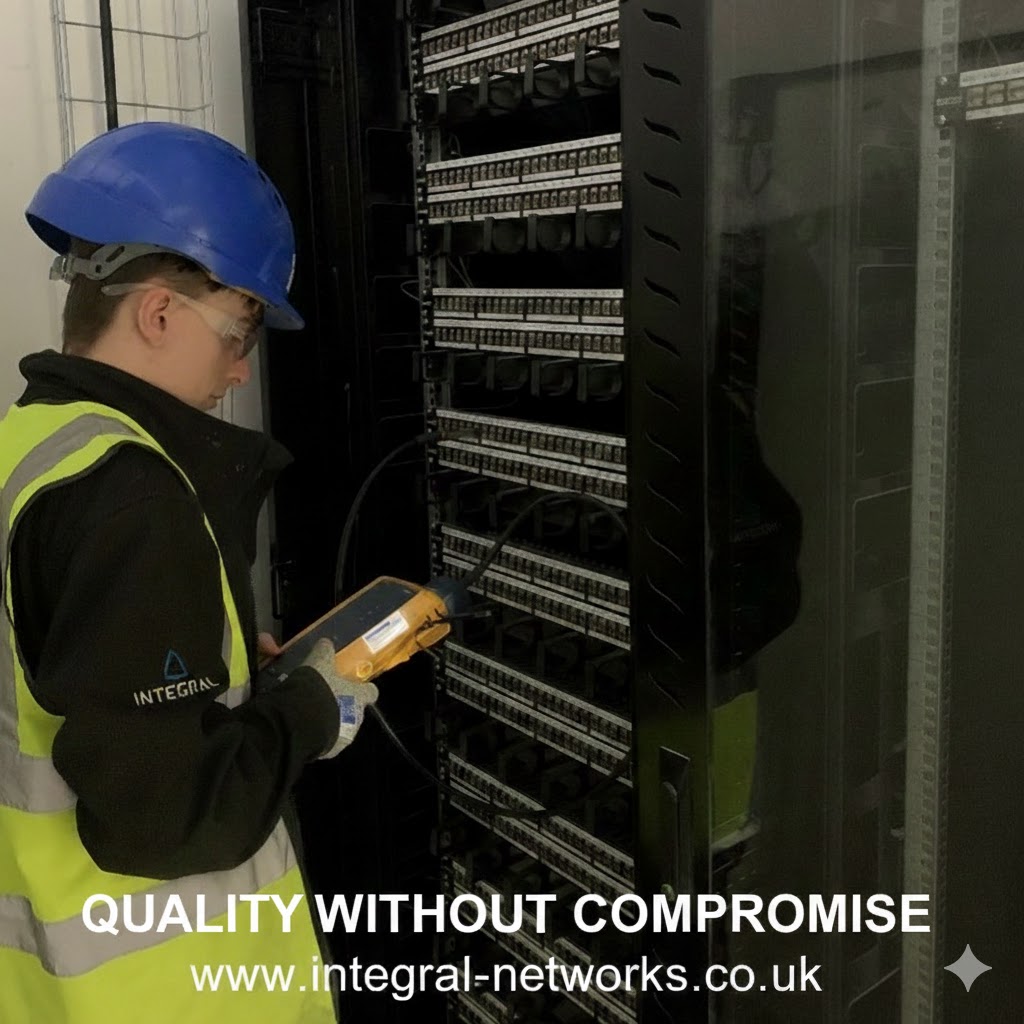
Professional Fluke testing provides a much clearer picture of the condition and performance of your cabling.
At Integral Network Solutions, we test every cable and fibre core rather than simply assuming that everything is working because devices can connect.
Testing can identify problems such as:
Wiring faults
Poor connections
Excessive resistance
Performance issues
Installation problems
Cabling that doesn't meet the required specification
Just as importantly, testing provides documented evidence of the installation's performance.
Don't just take your cabling installer's word for it. Ask for the proof.
A professional installation should leave you with test results and documentation that demonstrate the work has been completed correctly.
7. Network Downtime Is Becoming More Frequent
Perhaps the biggest warning sign is recurring network downtime.
Are you experiencing:
Intermittent connection problems?
Devices randomly dropping off the network?
Unexplained slowdowns?
Connections that keep failing?
Recurring faults in the same area?
IT equipment that appears to work one minute and not the next?
It's tempting to replace the affected device or blame the internet connection.
But if the underlying problem is your network cabling, replacing equipment may simply treat the symptom rather than fix the cause.
Your network infrastructure sits underneath everything else.
If the cabling is damaged, poorly installed, incorrectly terminated or simply no longer suitable for your requirements, it can cause problems that are difficult to diagnose.
A professional network health check can help identify potential weaknesses before they develop into a much bigger problem.
Why Your Network Infrastructure Matters
Your network infrastructure might be completely out of sight.
But it should never be out of mind.
Reliable data cabling and fibre optic infrastructure provides the foundation for your business network. It supports communication, cloud services, VoIP, wireless connectivity, security systems and future technology.
When your infrastructure is properly designed, installed, tested and documented, your IT team has a much stronger foundation to work from.
And when your business grows, you have an infrastructure that can grow with it.
What Does Good Network Infrastructure Look Like?
A professional network cabling installation should be about much more than running cables from A to B.
It should involve:
✔ Correct design – infrastructure designed around your current and future requirements.
✔ Quality components – compatible, certified cabling and connectivity components.
✔ Professional installation – installed to the appropriate industry standards.
✔ Accurate testing – every cable and fibre core tested and verified.
✔ Clear labelling – outlets, patch panels and cables clearly identified.
✔ Complete documentation – test results, drawings and schedules supplied at handover.
✔ Future planning – infrastructure designed with expansion and technology changes in mind.
That's how you turn a collection of cables into a properly structured network infrastructure.
Could Your Data Cabling Be Holding Your Business Back?
If you're experiencing slow network speeds, recurring faults, messy communications cabinets or unexplained downtime, it could be worth looking beyond your computers and internet connection.
The problem might be somewhere you can't see.
At Integral Network Solutions, we design and install structured data cabling and fibre optic systems for businesses across Yorkshire and beyond.
From smaller commercial offices to schools, universities, hospitals and larger commercial projects, we provide a complete service from initial survey and design through to installation, testing and handover.
Every installation is professionally tested using Fluke equipment and supplied with clear documentation. Our cabling installations also come with a 25-year manufacturer-backed warranty, giving you confidence that your infrastructure is built for the long term.
We also offer a Free Network Health Check, helping businesses understand what's happening behind the scenes and identify potential problems before they become expensive disruptions.

FAQ's
Other Articles
Explore practical guidance on infrastructure planning and deployment