How NOT to Install Data Cabling: 5 Common Cabling Mistakes
How NOT to Install Data Cabling: 5 Common Cabling Mistakes That Could Cost Your Business
A little bit of tape, a few loose wires and fingers crossed that everything works? We've seen it all!
When it comes to installing a business network, there's a right way and a wrong way to do things. Unfortunately, our engineers occasionally come across examples that make us wonder what was going through the installer's mind!
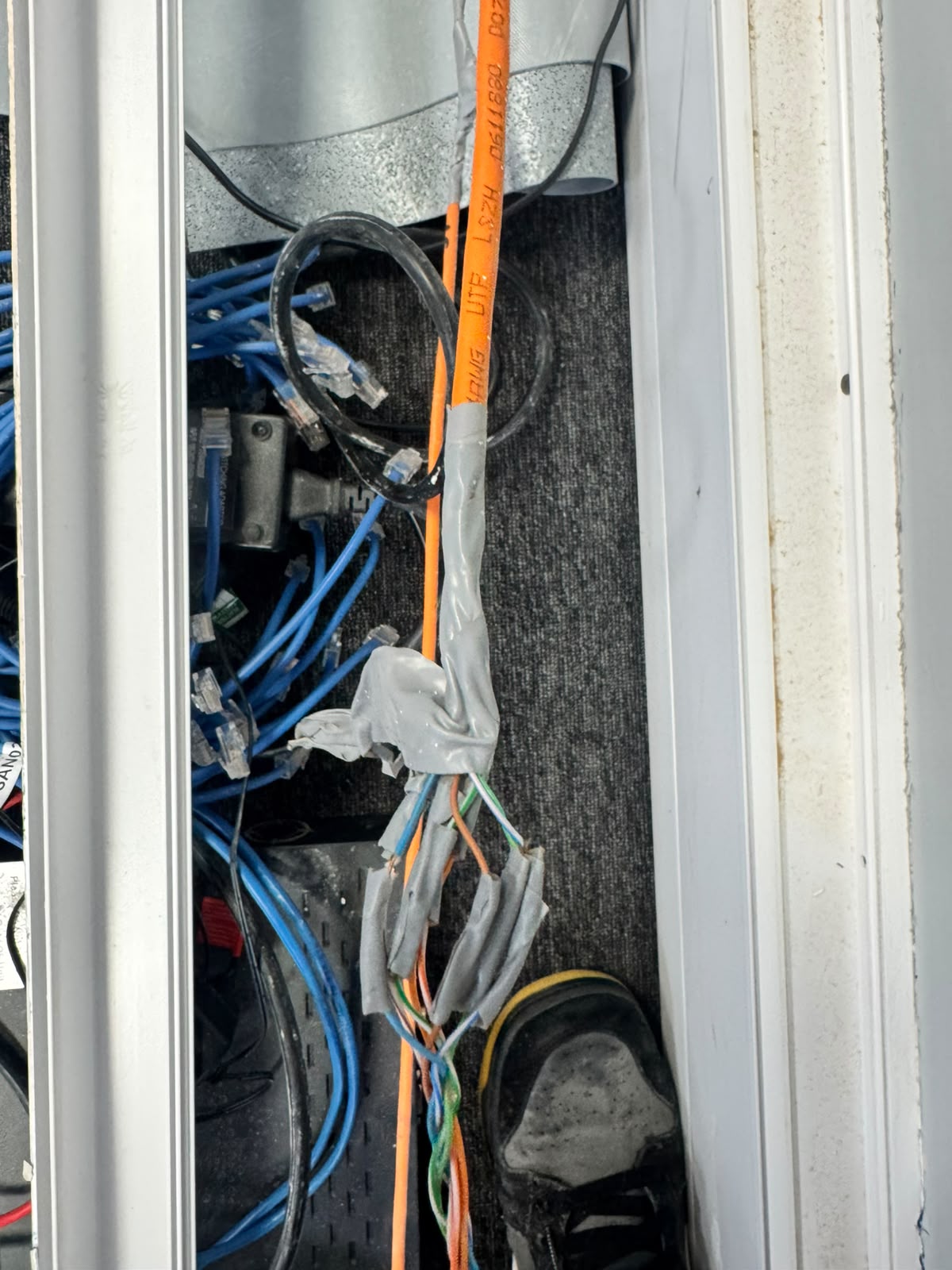
During a recent job, our engineers came across the installation pictured below. What should have been a properly installed and managed cabling system looked more like a collection of cables held together with whatever happened to be in the toolbox.
We're not quite sure what the original installer was aiming for, but one thing is certain: this isn't how we do things at Integral Network Solutions!
It might look like a quick and easy fix, but poor data cabling installation can cause problems that go far beyond appearances. From intermittent network connections to difficult fault-finding and expensive remedial work, cutting corners with your network infrastructure can cost your business time and money.
So, let's look at some of the common mistakes we come across, why they matter and what a professional data cabling installation should look like.
1. Using tape instead of proper cable connections
Let's start with the obvious one!
Tape has its uses, but holding cables together and hoping for the best isn't a professional method of installing a structured cabling network.
Data cables need to be correctly terminated using suitable connectors, modules or patch panels, depending on the installation design. Connections must be made in accordance with the manufacturer's instructions and relevant cabling standards.
Why does this matter?
Modern network cabling relies on carefully manufactured cable construction. Inside a Cat6 or Cat6A cable, the individual copper conductors are twisted together in pairs. These twists help reduce interference and maintain the electrical performance of the cable.
Poor terminations, damaged conductors or excessive untwisting can affect the performance of a network link.
Simply wrapping damaged or disconnected cables in tape doesn't restore their performance or create a compliant network connection.
At Integral, we believe in doing the job properly first time. You won't find our engineers holding your network together with sticky tape!
2. Poor cable management – a tangled mess waiting to happen
Cable management isn't just about making an installation look tidy. It plays an important role in protecting the network infrastructure and making future maintenance easier.
In the photograph, there are cables running in different directions, loose connections and what appears to be a collection of cables bundled together without any obvious organised management.
A poorly managed cabling installation can create several problems:
Difficult fault-finding: When something stops working, engineers need to identify the correct cable quickly. Without organisation, this can become a lengthy process.
Accidental disconnections: Loose and unsupported cables can be pulled, snagged or disconnected when someone is working in the cabinet.
Cable damage: Cables that are crushed, kinked or bent too tightly can suffer damage that affects their performance.
Future expansion: Adding new network connections becomes much harder when the existing infrastructure is already a tangled mess.
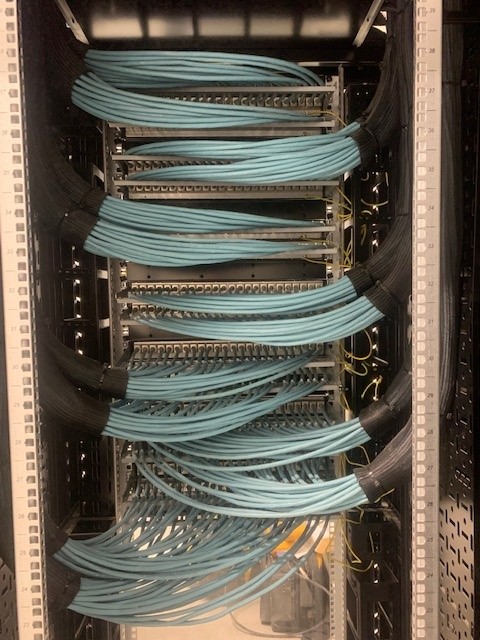
A professional installation should have cables routed neatly, supported appropriately and organised to allow easy access.
Good cable management also means considering bend radius requirements, avoiding unnecessary strain and keeping power and data cabling appropriately separated.
A tidy installation isn't just pleasing to the eye. It makes life considerably easier for whoever has to maintain the network in the future.
3. Damaged cables and exposed conductors
Network cables are designed with specific construction requirements to deliver reliable performance.
The outer sheath protects the internal conductors and helps maintain the cable's physical integrity. Removing too much of the sheath, damaging the internal insulation or interfering with the twisted pairs can compromise the cable.
When installing structured data cabling, engineers must take care to:
Avoid crushing or stretching cables during installation.
Maintain the manufacturer's minimum bend radius.
Avoid excessive untwisting of the copper pairs at termination points.
Protect cables from sharp edges and potential physical damage.
Use the correct termination components for the cable category.
It is also important to remember that a cable can look perfectly fine on the outside but still fail to meet its required performance.
That's why simply looking at an installation isn't enough. Proper testing is essential.
4. No labelling – the network guessing game!
Imagine your business has a network problem. You call an engineer, they open the cabinet and discover dozens of identical blue cables with no identification.
Now the fun begins!
Which cable goes to which office? Which one connects to the server? Which connection serves the CCTV system? And which one has been disconnected somewhere along the way?
Without proper labelling, engineers can spend valuable time tracing individual cables instead of getting straight to the problem.
A professional structured cabling installation should include clear and consistent labelling at both ends of each cable, with identification that corresponds to the network drawings and handover documentation.
This provides several benefits:
Faster fault-finding and troubleshooting.
Easier network maintenance.
Simpler upgrades and additional installations.
Better understanding of the existing infrastructure.
- Less disruption when changes are required.
At Integral, we believe the job isn't finished when the cables are installed. The customer should also have the information they need to understand and maintain their network.
5. No testing – just because it connects doesn't mean it's working properly!
This is probably one of the most important points.
One of the biggest misconceptions about data cabling is that if a computer connects to the network, the cable must be working correctly.
Unfortunately, that's not necessarily the case.
A network connection might work today but still fail to deliver the performance expected from the installed cable category.
For example, a poorly installed Cat6A cable might establish a connection, but that doesn't automatically mean it will achieve the performance required for a 10 Gigabit network.
Professional testing identifies whether each installed cable link meets the required performance specifications.
At Integral Network Solutions, testing is a fundamental part of every installation.
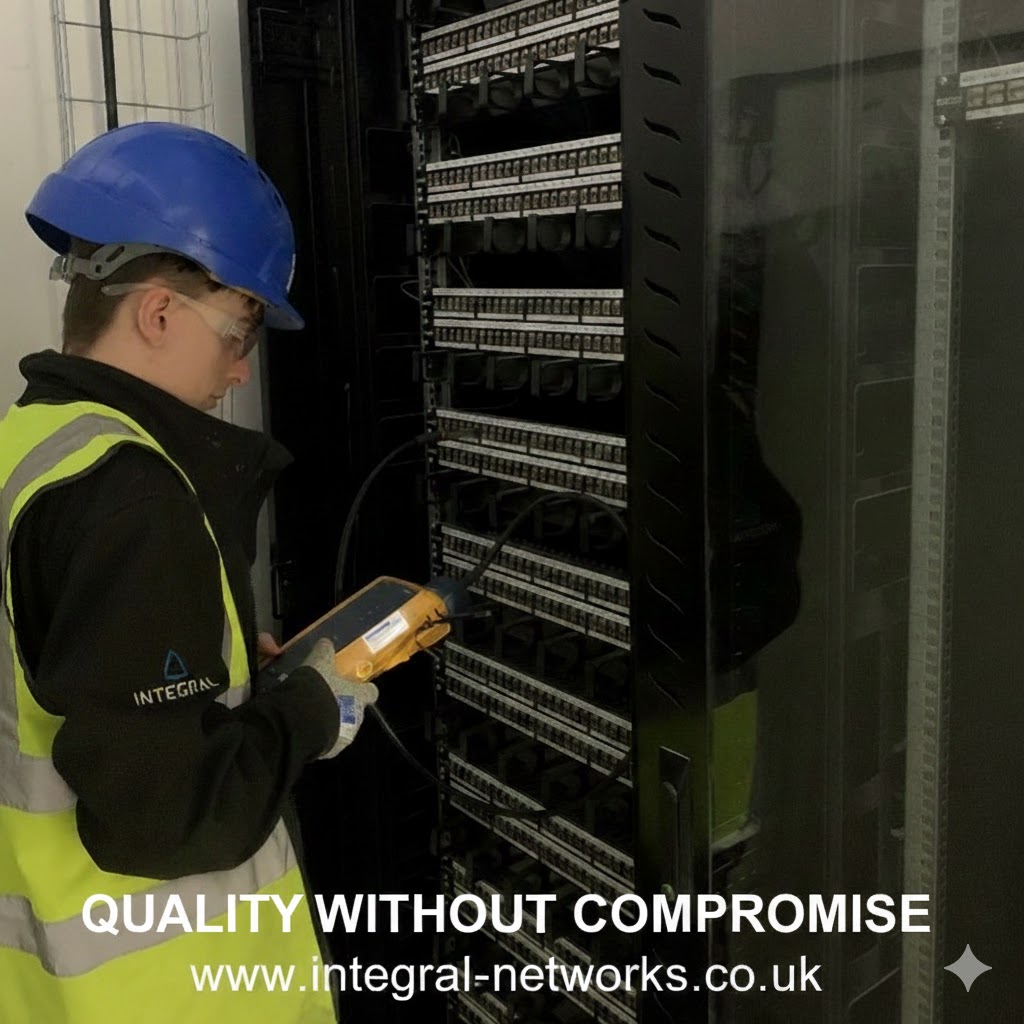
Our engineers use professional Fluke testing equipment to test installed copper and fibre optic cabling.
Depending on the installation, testing can identify issues such as:
Incorrect wiring and termination faults.
Excessive insertion loss.
Return loss problems.
Near-end and far-end crosstalk issues.
Length and performance problems.
Fibre optic loss and other transmission faults.
Every installed link needs to meet the relevant acceptance criteria. We don't simply plug a cable in, see a light come on and call it a day!
We provide test results as part of our handover documentation, giving customers evidence of the performance of their installed infrastructure.
Because when it comes to your business network, you should know exactly what you're getting.
Why do data cabling standards matter?
Professional data cabling installations should be designed and installed in accordance with recognised industry standards.
Two particularly important standards are:
BS EN 50173 – Information Technology: Generic Cabling Systems
This series of standards covers the design and performance requirements for generic cabling systems.
BS EN 50174 – Information Technology: Cabling Installation
This series covers the planning, installation and quality requirements associated with information technology cabling.
Following the appropriate standards helps ensure that the network infrastructure is installed correctly and is suitable for its intended purpose.
At Integral, we take these requirements seriously. We understand that the cabling infrastructure is the foundation of a business's network, and getting it right from the beginning matters.
What should a professional data cabling installation look like?
So, what should you expect when you pay for a professional data cabling installation?
At Integral Network Solutions, we follow what we call our three key ingredients for a reliable network:
1. The right cables and components
Using quality products from reputable manufacturers that are suitable for the intended network requirements.
2. Installation to the correct standards
Making sure the infrastructure is designed, installed and terminated correctly, with attention to cable management and workmanship.
3. Professional testing
Testing every installed cable and fibre core using the appropriate equipment to verify performance.
These three elements work together. You can have the best cable in the world, but if it isn't installed or terminated correctly, you could still end up with problems.
And that's why we never believe in cutting corners.
Could your existing network cabling be hiding problems?
If you've inherited an existing network, moved into new premises or simply haven't had your cabling checked for years, it might be worth taking a closer look.
You might not have a cabinet quite as interesting as the one our engineers discovered, but that doesn't mean everything behind your office walls or above your ceiling is in good condition!
Signs that your network cabling might need attention include:
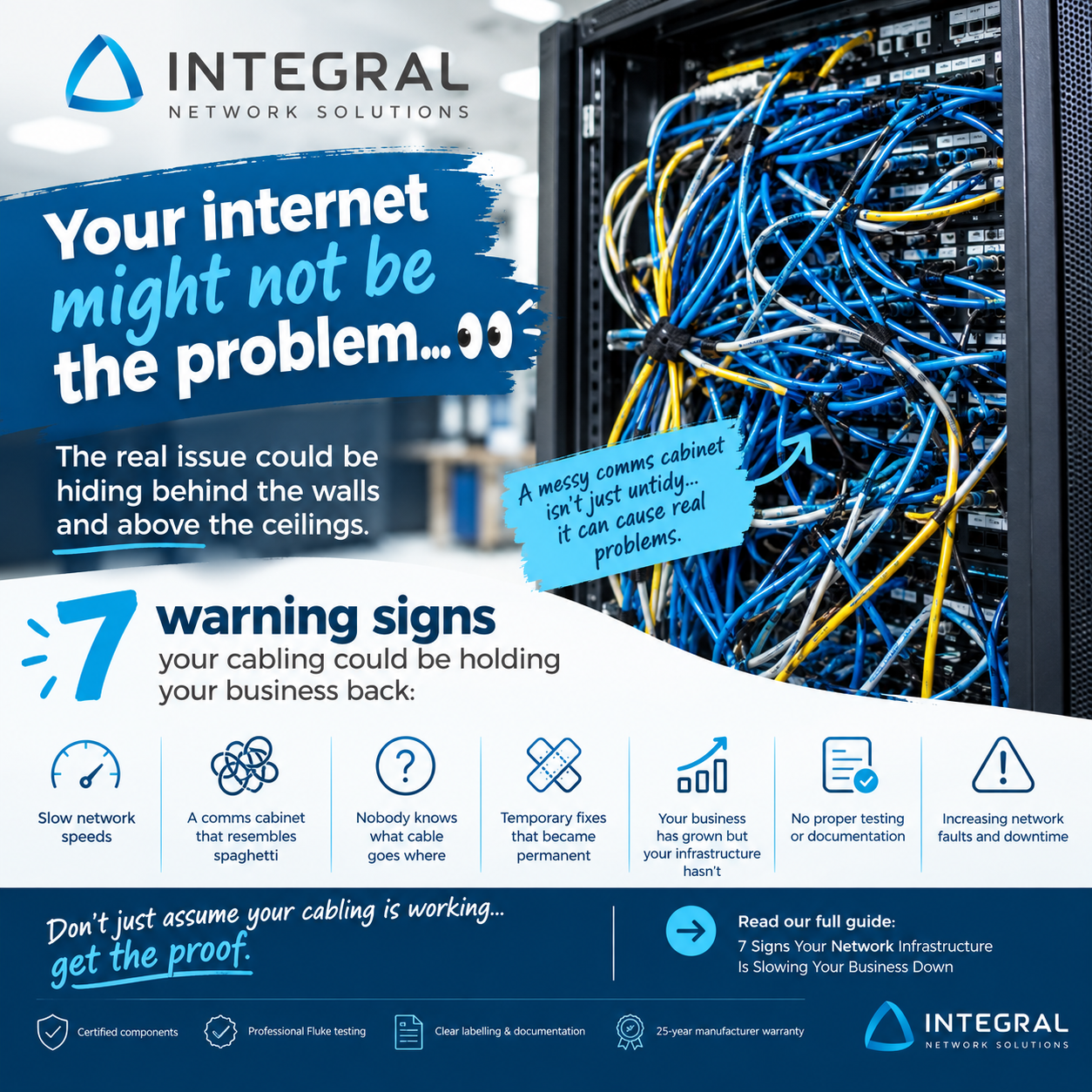
Untidy or overcrowded communications cabinets.
Unlabelled cables and connections.
Damaged or unsupported cabling.
Frequent network connection problems.
Unknown or missing network drawings.
No record of previous cable testing.
Difficulty identifying individual network connections.
Sometimes a network just needs a little organisation. Other times, it may benefit from a more thorough assessment.
That's where our FREE Network Health Check (Network MOT) can help.
Our team can carry out a visual review of your existing network infrastructure, looking at the condition and organisation of your cabling and available network documentation.
We'll help identify potential concerns and make recommendations on what could be improved.
There's no obligation to proceed with any recommended work.
At Integral, we do things differently
We're a family-run business based in Barnsley, specialising in commercial data cabling and fibre optic installations.
With nearly 20 years in business, we've built our reputation on quality workmanship, professional standards and, most importantly, looking after our customers.
We work with businesses across a range of sectors, including education, healthcare, commercial offices and industrial environments.
From a single data point to a complete structured cabling installation, our approach remains the same:
Free site surveys and quotations.
Professional network design.
Quality cabling and components.
Installation to recognised industry standards.
Comprehensive copper and fibre optic testing.
Clear labelling and handover documentation.
Ongoing support when you need us.
We also offer a 25-year manufacturer-backed cabling warranty on qualifying installations.
Because we believe that a network installation should be something you can rely on for years to come.
And just to be clear, if you choose Integral, you won't be getting your cables taped together and hoping for the best!
We'd much rather spend the time getting it right.
Need a professional to take a look at your network?
Integral Network Solutions – Quality cabling. Professional installation. Performance you can rely on.

FAQ's
Other Articles
Explore practical guidance on infrastructure planning and deployment